The Real Mafia
Cosa Nostra — literally “our thing” — is an Italian-American organized crime syndicate that dominated the American underworld for most of the 20th century. Its roots lie in Sicily, where the first criminal clans emerged in the mid-19th century. With the mass emigration of Italians to the U.S. at the turn of the 19th and 20th centuries, the Mafia moved across the ocean and took root in New York, Chicago, and other major cities.
During Prohibition (1920–1933), the Mafia grew exponentially wealthy through alcohol smuggling. In 1931, Lucky Luciano organized the Commission—a central body to resolve disputes between families. Five New York families were formed, which to this day bear the names of their founders. At the height of its power in the 1950s–1970s, the Mafia controlled labor unions, the construction industry, port operations, gambling, and drugs.
The Five New York Families
The Gambino Family
The most powerful of the fiveOriginally the Mangano family, renamed after Carlo Gambino, who led it from 1957 until his death in 1976. Under his rule, it became the most powerful criminal organization in the U.S.—controlling ports, labor unions, and the construction industry throughout New York.
After Gambino, Paul Castellano briefly led it until John Gotti had him shot in 1985 right in front of Sparks Steakhouse in Manhattan. The Gotti era brought the family both widespread publicity and its downfall — Gotti was sentenced to life in prison in 1992.
The Genovese Family
The “CIA Division” of the underworldThe oldest and traditionally most disciplined of the five families. Founder Lucky Luciano transformed it into a modern criminal corporation in the 1930s. After his deportation, Frank Costello took control, followed by Vito Genovese—the family bears his name.
The Genovese are renowned for always prioritizing discretion over publicity. In the 1980s, they were nicknamed the “CIA of the criminal underworld” due to their impenetrable conspiracy and internal security. They remain active to this day.
The Lucchese Family
Kings of the Airport IndustryNamed after Gaetano “Three-Fingered Brownie” Lucchese, who led the family from 1953 until his death in 1967. The Luccheses controlled the garment industry in Manhattan and, above all, JFK Airport—where their operations inspired a scene from the movie Goodfellas.
Henry Hill, the informant whose story Goodfellas tells, was an ally of the Lucchese family. The 1978 JFK heist (the Lufthansa heist—$6 million ) is the largest cash heist in American history.
The Bonanno Family
The basis for The SopranosJoseph “Joe Bananas” Bonanno led it from 1931 and was one of the most powerful bosses of his era. In the 1960s, he attempted a coup—the so-called “Banana War”— and was temporarily stripped of his seat on the Commission. The family never fully regained its former power.
In the 1980s, FBI agent Joseph Pistone infiltrated the family under the alias Donnie Brasco—his six-year undercover operation is the basis for the film of the same name starring Johnny Depp. The Bonanno family also inspired The Sopranos.
The Colombo Family
The smallest, but the most turbulentRenamed after Joe Colombo in 1970 — he was the only one of the five family bosses to publicly strive to legitimize the Mafia’s image and challenge Italian-American stereotypes. He was shot dead at his own public rally in Central Park in 1971.
The Colombo family is the smallest of the five, but notorious for internal strife—in the 1990s it endured a devastating internal war that paralyzed its operations for years to come. Nevertheless, it survived and remains active.
Chicago Outfit
Al Capone’s EmpireTechnically not one of the five New York families, but the Chicago Outfit is the second most influential Italian-American criminal organization in U.S. history. Under Al Capone’s rule in the 1920s, it controlled all of Chicago—the police, politicians, judges, and the media.
After Capone’s imprisonment (1931), control passed to Paul Ricca and Sam “Momo” Giancanua, who became famous for his ties to the CIA and the Kennedy family. The Chicago Outfit controlled Las Vegas casinos in the 1950s–1970s through “skimming”—the systematic theft of revenue before it was recorded.
Underworld Legends

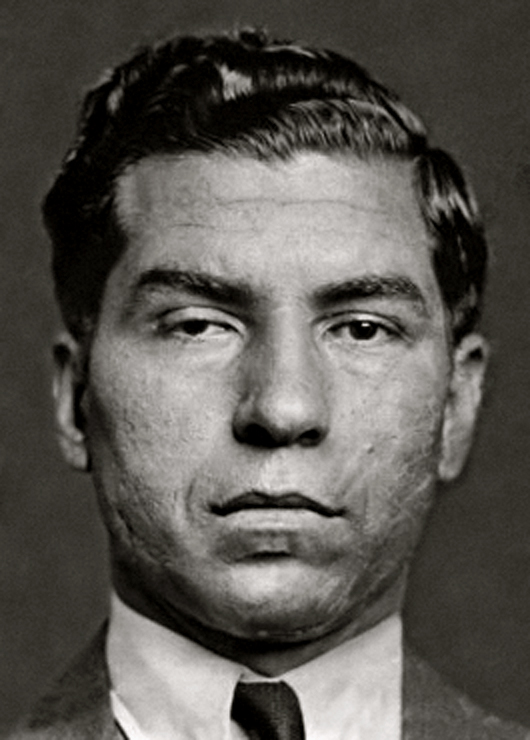
Charles “Lucky” Luciano
“Father of the Modern Mafia”Born in 1897 in Sicily, died in 1962 in Naples. His real name was Salvatore Lucania — Luciano was the most important figure in the American Mafia of the 20th century. In 1931, he organized a series of murders of the remaining old-school bosses, the so-called Mustache Petes (Masseria, Maranzano), and united the Italian-American families under a single leadership.
He created the Commission—the Mafia’s central arbitration body, which managed relations between families and prevented unnecessary wars. In doing so, he transformed the Mafia from a chaotic Sicilian tradition into a modern criminal corporation. In 1936, he was sentenced to 30–50 years for pimping. During the war, he collaborated with the U.S. Army during the invasion of Sicily—as a reward, he was deported to Italy in 1946 instead of going to prison.

Alphonse “Al” Capone
“Scarface” · “Big Al”Born in 1899 in Brooklyn, died in 1947 in Florida. The most famous gangster in history. Capone led the Chicago Outfit during Prohibition and built an empire based on bootlegging, prostitution, and gambling, with annual revenues estimated at $60 million.
The St. Valentine’s Day Massacre (February 14, 1929) — his men, dressed in police uniforms, shot and killed seven members of the Moran gang in a garage warehouse. Capone was in Florida at the time and had an alibi. Nevertheless, he became an incredibly famous public figure — the whole world knew his face. He was not convicted of murder, but of tax evasion — in 1931, he was sentenced to 11 years in federal prison at Alcatraz. He was released in 1939 with neurosyphilis, which gradually paralyzed him.

Carlo Gambino
“Don Carlo”Born in 1902 in Sicily, died in 1976 of natural causes—a rare occurrence for a boss of his stature. Gambino is considered the most successful Mafia boss in American history — he led his family for 19 years and died at his home on Long Island, never having been convicted of a serious crime.
Gambino was quiet, discreet, and methodical—the polar opposite of the media-savvy Gotti, who succeeded him. He refused to deal in heroin and preferred less risky operations. True power always lay behind the scenes—the inspiration for the character of Don Corleone in both the novel and the film The Godfather.

John Gotti
“Teflon Don” · “Dapper Don”Born in 1940 in the Bronx, died in 2002 in prison of cancer. Gotti became boss of the Gambino family in 1985 after having his predecessor, Paul Castellano, shot dead on a public street—an act unheard-of even by Mafia standards.
He was famous for his eccentric fashion sense (expensive suits, a different one every day), his media presence, and three acquittals—hence the nickname “Teflon.” The FBI eventually persuaded his underboss, Sammy “The Bull” Gravano, to cooperate. Gravano confessed to 19 murders in exchange for a reduced sentence. Gotti was sentenced in 1992 to life in prison without the possibility of parole.

Meyer Lansky
“The Mafia Banker”Born in 1902 in Poland (now Belarus), died in 1983 in Miami. A Jew of non-Italian origin—he was never a formal member of the Cosa Nostra, but he was the key financial mastermind of the entire American underworld for more than 50 years.
Lansky devised a system to turn money laundering through foreign banks (Switzerland, the Bahamas, Hawaii) into a systematic industry. He controlled casinos in Cuba (until Castro’s revolution in 1959), in Las Vegas, and in Florida. Estimated net worth at death: $300–400 million. The FBI monitored him his entire life but never convicted him of a serious crime. Inspiration for the character Hyman Roth in The Godfather Part II.

Frank Costello
"Prime Minister of the Underworld"Born in 1891 in Calabria, died of natural causes in 1973. Costello was the exact opposite of Capone—he never got his hands dirty with direct violence and built his power through the corruption of politicians, judges, and police officers. He was unofficially the most influential man in New York in the 1940s and 1950s.
His nickname “The Prime Minister” perfectly captures his style—he acted like a politician, not a gangster. He testified before the Kefauver Committee in 1951 during a live television broadcast, and his appearance was watched by tens of millions of Americans. He refused to show his face to the camera—so the television broadcast only shots of his hands. In 1957, he survived an assassination attempt—Vito Genovese wanted him eliminated. The inspiration for the character of Don Corleone—Marlon Brando studied Costello before playing the role.
Key Events
Prohibition — the golden age of the Mafia
The 18th Amendment to the Constitution banned the production and sale of alcohol. The Mafia continued to smuggle it— resulting in an explosive increase in revenue and power. It is estimated that Capone alone earned the equivalent of over a billion dollars a year in today’s prices.
The St. Valentine’s Day Massacre — Chicago
Capone’s men, disguised as police officers, murdered seven members of the Bugs Moran gang in a garage warehouse on North Clark Street. No one was convicted. The massacre shocked America and contributed to Capone’s downfall—he was too visible.
Bloody Summer — Formation of the Commission
Lucky Luciano had bosses Giuseppe Masseria (April) and Salvatore Maranzano (September) murdered — both of the old Sicilian school. He then summoned all the American families and established the Commission — a council of bosses that regulated territories and disputes. The system operated unchanged for over 50 years.
The Apalachin Meeting — the largest Mafia convention
Over 100 bosses from across the U.S. gathered at a farm in Apalachin, New York. A local police officer happened to notice an unusual number of expensive cars and called for backup. Dozens of bosses were arrested while fleeing through the woods in their elegant suits. The meeting irrefutably proved the existence of a nationwide network—the FBI could no longer deny it.
The RICO Act — The End of Impunity
The Racketeer Influenced and Corrupt Organizations Act made it possible to prosecute entire organizations, not just individuals. For the first time, prosecutors could prove the systematic nature of the crime and seek much harsher penalties. RICO became the most effective weapon against the Mafia.
The Commission Trial — The End of the Golden Age
Federal prosecutor Rudy Giuliani brought the bosses of all five families to trial at once. The Gambino, Lucchese, Colombo, Genovese, and Bonanno families—all convicted. Sentences ranging from 40 to 100 years. The Mafia never fully recovered from this blow.
The Fall of the Teflon Don
John Gotti—acquitted three times—was sentenced to life in prison thanks to the testimony of his closest associate, Sammy Gravan. Gotti’s conviction symbolized the end of an era when it was possible to become a famous public figure while remaining unpunished.
Comments 0
No comments yet. Be the first!
Add comment